Is the first year of commercial use of humanoid robots really coming?

As the best carrier of embodied intelligence, humanoid robots are on fire.
Recently, Figure released a new video of Figure 01, the company's first humanoid robot, which can recognize objects in front of you, answer open-ended questions, and follow instructions to pack black plastic bags into frames and place cups and plates on drain racks. Its ability to identify, converse and think is impressive.
Earlier this year, domestic UBTECH also showed a practical training video of its Walker S humanoid robot at NIO's new energy vehicle factory. In the video, the Walker S successfully completed the inspection of the car door lock, seat belt, and lamp cover, and smoothly affixed the car logo.
Almost instantly, Chinese and foreign technology giants and start-ups have laid out the humanoid robot market. The investors behind Figure include Amazon, Nvidia, Microsoft, and OpenAI; Tesla's Optimus, Xiaomi's CyberOne, Unitree's H1, and Zhiyuan Robot's Expedition A1 are all popular humanoid robots that have attracted market attention. There is even news that Apple sees humanoid robots as "the next big thing".
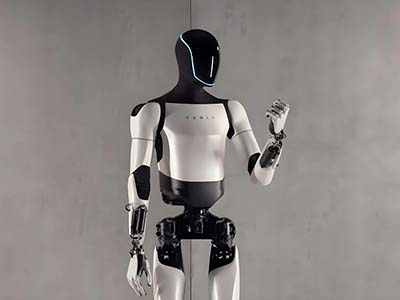
Tesla Optimus humanoid robot
Even in the capital market, once the concept of humanoid robots is stained, the stock price has soared. Some people shouted that 2024 will usher in the first year of commercial use of humanoid robots!
With the blessing of AI, the prospects are broad
Whether in film and television works or in reality, humanoid robots are not a new thing, but why have they now become a competition outlet and investment hotspot for all parties?
The answer is the surging wave of artificial intelligence. It can be said that based on the empowerment of AI technology, we are witnessing significant progress in humanoid robots, and the integration of end-to-end AI and multimodal AI algorithms has also greatly accelerated the speed of product iteration.
For example, the aforementioned Figure 01 is powered by OpenAI's ChatGPT model; UBTECH's Walker S, the partner is Baidu's Wenxin model.
With the blessing of AI, humanoid robots and humans have realized multimodal interactions, and through functions such as perception, learning, action, and planning, humanoid robots can truly perform various tasks in various environments, and can be easily integrated into existing factory processes or infrastructure.
In the future, humanoid robots have broad application prospects in scenarios such as industrial manufacturing, commercial services, and home companionship. Goldman Sachs predicts that the humanoid robot market is expected to reach $38 billion in 2035, and some institutions believe that the market for humanoid robots will reach more than $100 billion in 2035.
In terms of industrial policy, humanoid robots are also receiving strong support. The Ministry of Industry and Information Technology issued the "Guiding Opinions on the Innovation and Development of Humanoid Robots" at the end of last year, saying that humanoid robots integrate advanced technologies such as artificial intelligence, high-end manufacturing, and new materials, and are expected to become disruptive products after computers, smartphones, and new energy vehicles. The goal is that by 2025, the humanoid robot innovation system will be initially established, the whole machine products will reach the international advanced level, and mass production will be realized, and it will be demonstrated and applied in special, manufacturing, people's livelihood services and other scenarios.
It can be said that under the two-wheel drive of policy and capital, the humanoid robot industry is expected to usher in leapfrog development and become a new growth pole in the field of artificial intelligence.
What hurdles are there in the large-scale commercialization?
Although the trend of industrial landing is clear, the growth space has been opened, and the humanoid robots of various companies have also been displayed, it should be said that the humanoid robot is still in a commercial verification process from 0 to 1, rather than a rapid development stage from 1 to 10.
The commercialization of humanoid robots may still have some way to go. The first is the currently high manufacturing cost of humanoid robots.
Compared with traditional robots, humanoid robots require less than an order of magnitude in terms of core components such as precision reducers, controllers, servo systems, and high-performance drives.
According to UBTECH's IPO prospectus, the total income of the 10 humanoid robots sold by UBTECH is close to 60 million, that is to say, the price of each unit is about 6 million, which is obviously not affordable by few factories or individuals.
Tesla's Optimus humanoid robot is estimated to cost between $150,000 and $200,000 per unit, which is equivalent to more than one million yuan. Musk said that Tesla is confident that the price of the Optimus can be reduced to less than $20,000 in the future, which is cheaper than a car.
Obviously, continuous cost reduction in manufacturing is an important prerequisite for the large-scale landing of humanoid robots.
The other is the performance of humanoid robots.
Although the "intelligence" level of humanoid robots is constantly improving, there is still room for improvement in gait algorithm, terrain adaptability, operation accuracy, and cooperative operation ability. These technical challenges require further breakthroughs in order to meet the requirements for stability and efficiency, for example, in the industrial sector.
In addition, humanoid robots also need powerful computing power to process complex data and perform precise actions. At the same time, the collaboration and optimization of algorithms is also the key to improving the performance of humanoid robots. How to balance cloud and edge computing, and how to improve the efficiency and accuracy of algorithms, is a major technical challenge for humanoid robots.
It is also important to note that humanoid robots need good endurance when working for long periods of time. Compared with traditional robots and collaborative robots, which can work for a long time with electricity, how to optimize energy management and heat dissipation design to improve the work efficiency of humanoid robots and reduce downtime is another problem that needs to be solved.
Finally, the safety and reliability of humanoid robots are also crucial. How to ensure the stable operation of the robot under various working conditions, as well as emergency treatment in the event of failure, is a factor that people have to consider.
However, regardless of whether this year is the first year of commercial use, humanoid robots have undoubtedly entered a stage of accelerated development and have become a commanding heights for all parties to seize scientific and technological competition and future development. This market is still quite worth looking forward to, after all, who doesn't want to wait for their old age, there is a humanoid robot that can provide you with meticulous service!
From chips, systems to applications, Hejian Industrial Software has written a new pattern of domestic industrial software
SICK and E+H join forces to create a new chapter in the field of process automation
Related Article