From R&D and design to innovation capabilities, how will AI models disrupt the future industry?
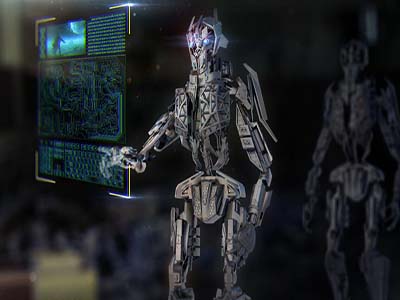
"Manufacturing is an important battlefield for AI models, and the biggest opportunity in the next 10 years lies in the integration of cloud, AI and physical machines...... In the future, intelligent robots that can directly talk to people will change the shape of the entire factory. ”
Recently, at the 6th Digital China Construction Summit, Daniel Zhang, chairman and CEO of Alibaba, said. He revealed that Alibaba Cloud engineers are experimenting with connecting the Tongyi Qianwen large model to the industrial robot, and entering a human language in the DingTalk dialog box to remotely command the robot to work.
A water intake demonstration video released by Alibaba Cloud on the same day shows the results of this experiment. After the engineer sends instructions to the robot through the DingTalk dialog box, the Tongyi Qianwen model automatically writes a set of code in the background and sends it to the robot, and the robot begins to identify the surrounding environment, finds a bottle of water from the nearby table, and automatically completes a series of actions such as moving, grabbing, and distributing, and delivers it to the engineer. This demonstration shows that the AI model has broken through the limitations of robots, allowing humans to direct machines to complete responsible tasks through natural language, so that robots really have "brains".
According to Alibaba Cloud engineers, large AI models can play an important role in the development and application of robots. For example, when the production is running, the Tongyi Qianwen model provides the ability for the robot to perform the task with the ability to reason and make decisions, and the front-line worker only needs to send a piece of text, and the Tongyi Qianwen can understand its intention to reason about the task, and automatically translate it into code that the machine can understand, command the machine to perform the task, and effectively improve production efficiency.
AI has shown great potential and value in various fields. In manufacturing, AI can improve production efficiency, reduce costs, optimize quality, enhance innovation capabilities, and more. With the continuous development and progress of AI technology, especially the emergence of AI large model technology represented by ChatGPT, the application prospect of AI in the future industry will be broader and more profound.
First of all, let's understand what an AI model is.
AI large models refer to artificial intelligence models with ultra-large-scale parameters and data, such as Baidu's Wenxin Yiyan, Alibaba's Tongyi Qianwen, and the global hit ChatGPT, the latest ChatGPT-4 has more than 100 trillion parameters, which is currently the world's largest natural language processing model. Large AI models can process massive amounts of information, generate high-quality content, such as text, images, audio, video, etc., and interact naturally and fluently with humans. AI large models can not only provide more accurate and comprehensive knowledge and services, but also create new knowledge and services, thereby enabling the ability of artificial intelligence generated content (AIGC).
In the author's view, the AI model can empower the industry from the perspectives of R&D and design, manufacturing, and management services, and promote the transformation of the manufacturing industry to intelligence, digitalization, and networking.
- R&D and design: AI large models can be integrated with CAD, EDA, CAE and other industrial design software, and use cloud computing and big data to automatically generate or optimize design solutions to improve design efficiency and accuracy. For example, Cadence has introduced Allegro X AI technology, a next-generation system-on-chip design technology that leverages generative AI capabilities to streamline the system design process and reduce PCB design turnaround time by one-tenth.
- Manufacturing: Through the integration with intelligent industrial equipment such as industrial robots, AGVs, and machine tools, AI large models can use technologies such as natural language processing and computer vision to achieve natural interaction and collaboration with humans, and improve production efficiency and quality. For example, Siemens combines ChatGPT technology with its existing natural language technology to effectively realize the interaction between the operator and the system's natural language. BMW relies on NVIDIA's Omniverse platform to virtually optimize the layout of production lines, robots, and logistics systems, strengthen global factory connections, and improve service efficiency.
- Management services: AI large models can be integrated with industrial management software such as ERP, CRM, MES, etc., and use technologies such as natural language generation and understanding to automatically generate or optimize relevant documents and reports to improve management efficiency and level. For example, Microsoft launched GPT's interactive AI capabilities commercial products Dynamics 365 Copilot and Microsoft 365 Copilot, which greatly improve users' work efficiency in business management software, and are expected to further expand to other scenarios such as supply chain management, customer service, and marketing in the future.
- Innovation ability: The AI model can be integrated with the industrial Internet platform and the industrial innovation center, and use technologies such as knowledge graph and recommendation system to automatically generate or optimize innovative solutions and services to improve innovation ability and value. For example, 4Paradigm has launched the enterprise-grade 4Paradigm SageGPT, which integrates large-scale generative language models with vertical domain expertise, and already has multimodal and Copolit capabilities in enterprise-level scenarios. Megvii Technology has begun to deploy in the field of visual large models to explore the feasibility of generative AI in the field of warehousing and logistics.
It can be said that whether you want it or not, AI technology has ushered in a period of explosion, and technology is developing rapidly. The manufacturing industry should use a positive attitude to look at the major changes that the AI model may bring to the manufacturing industry, and make full use of the more opportunities brought by the AI model to the manufacturing industry, promote the deep integration and coordinated development of the manufacturing industry and other industries, and form a new industrial ecology and competition pattern.
To boost the new quality productivity to accelerate the "mine entry", Yikong Intelligent Driving brought the Mountain 2.0 to the World Artificial Intelligence Conference
From chips, systems to applications, Hejian Industrial Software has written a new pattern of domestic industrial software
Related Article