


FA = Factory Automation?
I think many people have heard the term FA (factory automation). They are also sold as "FA parts" for machine parts. But what exactly is FA? Here we explain what FA is.
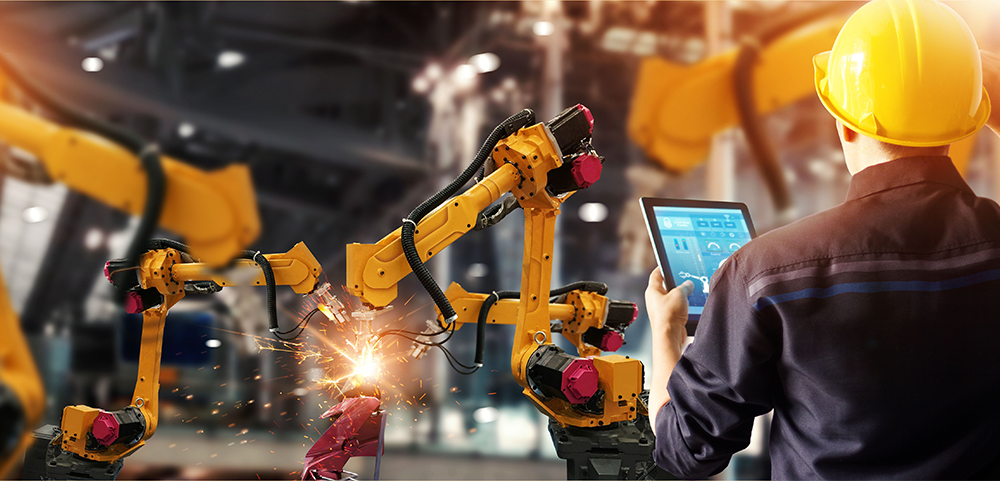
FA is an abbreviation for Factory Automation. That is, the meaning of factory automation. In an era where automation is so advanced, it does feel a little strange to emphasize "automation". But it is said that the term FA first appeared in the 50s of the 20th century, so it is not difficult to understand. The term was born in an era of frequent changes such as the electrification of machinery and the assembly of integrated circuits in machine tools, and the realization of industrial automation. Originally, the term was used to refer to industrial robots, but with the expansion of automation, FA has now become a word that covers a wide range of topics. Today, everything from small equipment that runs automatically on the production line to large machine tools, CAD, automatic conveyors, automatic inventory checkers, and the Internet of Things is all covered by FA. Let's look at a few specific examples of FA.

When mechanical parts are marketed as "FA parts", FA refers to assisting workers in their work or automating work performed manually by workers in an environment where they stand next to a production line to carry out their work. Specifically, FA is a device that automatically fixes the product to be assembled when it is placed on a jig, and a device that stacks two types of gaskets next to the production line and hands them out in a direction that is easy for workers to reach. Most of them are small devices that fit in the palm of your hand, and even large devices do not exceed your human height. This kind of automation equipment is not mass-produced and sold due to the variety of functions required for manufacturing and process. For this reason, in most cases, engineers from the production and manufacturing technology departments and manufacturers specializing in jigs are hand-made "one by one" according to the situation on site. That's why mechanical parts are considered "FA parts". In addition, the plant is equipped with a variety of automation FA devices, such as NC and autonomous unmanned conveyors.

There is also FA related to the system aspect, which also involves IT and digitalization. Databases (which store drawings created in CAD, as well as save and retrieve design change history and part numbers), BOM (bill of materials system), and CAM (a system that can process CAD drawings without manual programming, etc., can be stored and retrieved at the same time) are also included in FA. For example, in the case of CAM, in the past, it was necessary for the operator to manually enter the program into the processing equipment while reading the drawing. However, in recent years, it has become possible to obtain CAD data directly and program it automatically by the machine itself, taking into account the machining steps. This constant automation in terms of systems is also a form of FA. In recent years, there have also been movements such as Industry 4.0, and there is also a trend to link these systems with the Internet of Things to automate the factories themselves to a higher degree. In addition, there is a major trend to reduce labor through automation due to work-style reforms, difficulties in securing human resources, and reduction of labor costs. The ultimate goal of FA locked factories is to realize fully automated unmanned factories and unmanned manufacturing systems. But at least so far, few factories can reach this stage immediately.
As a result, FA is a very broad term that covers everything from the physical to the systematic. FA includes both grand projects such as the realization of unmanned factories through the Internet of Things and simple devices that assist workers in manual work on production lines. Therefore, when the question "What is FA?" arises. "When it comes to this kind of topic, it's important to know which part of it is talking about.
What is the most critical "datum" when reading and drawing drawings?
Visual inspection is the general trend of inspection
Related Article


