


Five Key Directions in the Development of Machine Vision Technology
In recent years, there have been unprecedented advancements in fields such as artificial intelligence (AI), big data, 3D imaging, and robotic process automation. Looking ahead, the development of machine vision technology is expected to follow these five key trends:
-
Expansion of 3D Imaging and Robotic Arm Applications Industrial automation is driving production lines to become more intelligent, replacing manual labor and reducing workforce demands. Machine vision has already been widely applied in quality control inspections, but with the emergence of integrated solutions combining 3D sensors and robotic arms, new markets are opening up. Robotic picking systems can now randomly grasp objects, regardless of their position and orientation. 3D vision systems are capable of recognizing randomly placed parts, such as suitcases and part bins. The dynamic handling capabilities of robots enable the selection of complex objects from various directions and stacks. Integrating AI with picking operations allows for autonomous part selection, improving productivity and cycle times while reducing the need for human-machine interaction.
-
Increased Applications of Deep Learning The advent of 5G networks provides autonomous vehicles with the capability to perform cloud-based machine vision computations. Massive machine-type communications (mMTC) allow for the processing of large volumes of data in the cloud for machine vision applications. Deep learning algorithms, such as those using convolutional neural network classifiers, can rapidly perform image classification, object detection, and segmentation. The development of these new AI and deep learning systems is expected to increase in the coming years.
-
Proliferation of Robots According to the International Federation of Robotics, 2018 was a record year for robot sales, with industrial robot sales increasing by 31%. Trends such as human-robot collaboration, simplified usability, and process learning are driving the adoption of robots in industrial automation. In the future, industrial robots will be easier and faster to program using intuitive interfaces. Human-machine collaboration will support flexible production with small batches and high complexity. As the complexity of use decreases, robots and vision systems are expected to see widespread adoption in the mid to long term.
-
Advancements in Hyperspectral Imaging Analysis and Detection The next generation of modular hyperspectral imaging systems offers chemical material performance analysis in industrial environments. Chemical color imaging visualizes the molecular structure of materials through images that display results in different colors. This enables the analysis of chemical components using standard machine vision software. Typical applications include plastic detection in meat production, detection of different recyclable materials, and quality control in pill inspection. The primary challenge for these systems lies in handling the required data volume and speed, but advancements in faster processing, better algorithms, and camera calibration continue to make this a hot topic.
-
Increased Adoption of Thermal Imaging for Industrial Inspection Thermal imaging cameras have traditionally been used in defense, security, and public safety applications, but their use in detection is expanding. For many industrial applications, such as component production in the automotive or electronics industries, thermal data is critical. While machine vision can identify production issues, it cannot detect thermal anomalies. The combination of thermal imaging with machine vision is an evolving field that allows manufacturers to identify problems that are invisible to the naked eye or standard camera systems. Thermal imaging technology provides non-contact precision temperature measurement and non-destructive testing, marking a key direction for the development of machine vision and automation control.
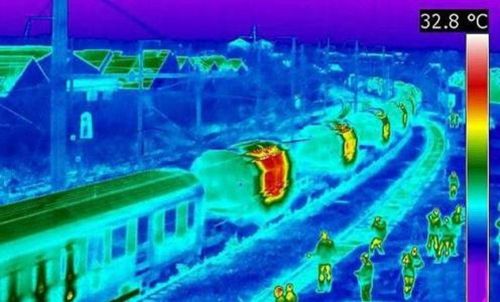
Schematic diagram of thermal imaging
Industrial automation technology related to machine vision is driving more change in the manufacturing industry. Machine vision is suitable for all industries, but it is especially important in high-spec, highly-regulated industries such as food and beverage, pharmaceutical, and medical device manufacturing. There are many reasons why companies turn to factory automation technology, and the difficulty of recruiting workers forces enterprises to automate their production lines and realize the replacement of manual labor by machines, including improving production line efficiency, using resources more effectively and improving productivity. It is speculated that the demand for machine vision-related technologies in various fields will continue to deepen and grow in the future.
Six Challenges Restricting the Development of the Sensor Industry
The Crucial Role of Smart Sensors in Industrial Automation
Related Article


