


Do AC Motors Have Brushes
2025-06-04
Do AC Motors Have Brushes?
When it comes to electric motors, the question “Do AC motors have brushes?” often arises, especially among those interested in the technical details of these essential devices. The answer isn't a simple yes or no, as it depends on the specific type of AC motor. Let's delve into the world of AC motors to understand the role of brushes and their presence, or absence, in different motor designs.
The Role of Brushes in Electric Motors
Before exploring AC motors, it's important to understand what brushes are and their function in electric motors. Brushes are typically made of carbon or graphite and are used to transfer electrical current from a stationary part (usually the power source) to a rotating part, such as the rotor, in an electric motor. They maintain electrical contact with the commutator (in DC motors) or slip rings (in some AC motors) to ensure a continuous flow of current, enabling the motor to operate smoothly.
Types of AC Motors and the Presence of Brushes
Induction Motors
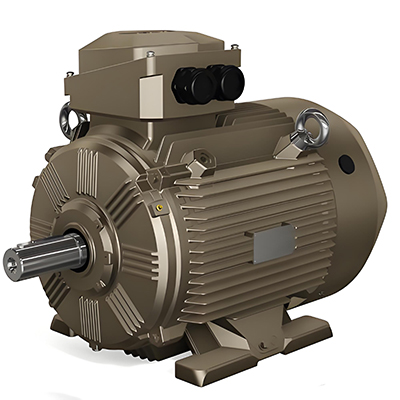
Induction motors are the most commonly used type of AC motors. They work on the principle of electromagnetic induction, where a rotating magnetic field in the stator induces current in the rotor. In general, standard induction motors, especially those with squirrel - cage rotors, do not have brushes. The squirrel - cage rotor consists of conductive bars short - circuited at both ends, and the current is induced in these bars without the need for brushes to supply electrical current. This design makes induction motors highly reliable, low - maintenance, and suitable for a wide range of applications, from fans and pumps to industrial machinery.
However, wound - rotor induction motors are an exception. These motors have a rotor with windings that are connected to external resistors through slip rings and brushes. The brushes in wound - rotor induction motors allow for controlling the motor's speed and torque by adjusting the resistance in the rotor circuit. So, while most induction motors are brushless, some specialized versions do incorporate brushes.
Synchronous Motors
Synchronous motors operate at a constant speed that is synchronized with the frequency of the AC supply. In the case of permanent - magnet synchronous motors (PMSMs), they typically do not have brushes. The permanent magnets in the rotor create a magnetic field that interacts with the rotating magnetic field of the stator, eliminating the need for electrical contact to the rotor via brushes.
On the other hand, synchronous motors with a separately excited rotor may use brushes. These motors have a DC - excited rotor, and the brushes are used to supply direct current to the rotor windings through slip rings. This allows for precise control of the motor's magnetic field and, consequently, its performance, making them suitable for applications where constant speed and high torque are required, such as in power generation and large industrial processes.
Single - Phase AC Motors
Single - phase AC motors, commonly used in household appliances and small - scale applications, also vary in their use of brushes. Many single - phase motors, like shaded - pole motors and capacitor - start motors, do not have brushes. Shaded - pole motors create a rotating magnetic field using a shading coil on the stator, while capacitor - start motors rely on a capacitor to create a phase difference in the stator windings, enabling starting without the need for brushes.
Nevertheless, there are some single - phase motors, such as universal motors, which can operate on either AC or DC power. Universal motors do have brushes, as they use a commutator similar to DC motors to reverse the current direction in the rotor windings, allowing them to work with alternating current.
Conclusion
In conclusion, the answer to whether AC motors have brushes is that it depends on the type of AC motor. While many common AC motors, including standard induction motors and some synchronous motors, are brushless, certain specialized AC motors, such as wound - rotor induction motors, some synchronous motors with separately excited rotors, and universal motors, do incorporate brushes for specific operational requirements. Understanding this helps in selecting the right AC motor for different applications and in maintaining and troubleshooting motor - related issues.
How Does a DC Motor Work
How Does an AC Electric Motor Work
Related Article

Brushless DC (BLDC) motors are widely used in EVs, drones, industrial machinery, and robotics for their efficiency and long lifespan. Unlike brushed motors—where reversing direction only requires swapping power leads—BLDC motors rely on electronic commutation, making direction reversal more nuanced.
How to Reverse Direction in Brushless Motors

Brushed and brushless DC motors are two of the most common electric motor designs, powering everything from toys to electric vehicles. While both convert electrical energy to mechanical motion, their internal structures, performance, and use cases differ drastically.
What’s the Difference Between a Brushed and Brushless Motor

Brushed DC motors are reliable, but wear and tear over time can lead to failure. Whether you’re troubleshooting a power tool, household appliance, or industrial conveyor motor, knowing the signs of a bad brushed motor saves time and prevents further damage.
How to Know If a Brushed Motor Is Bad
