


How Do Brushless DC Electric Motors Work
2025-06-06
How Do Brushless DC Electric Motors Work?
In the ever - evolving landscape of electric motor technology, brushless DC (BLDC) electric motors have emerged as a revolutionary force, powering everything from high - performance drones to electric vehicles. Understanding how these motors work is crucial for engineers, enthusiasts, and anyone interested in the mechanics of modern technology. In this blog, we will delve deep into the intricate workings of brushless DC electric motors.
1. The Basics: Structure of a Brushless DC Motor
1.1 Stator
The stator is a key component of a BLDC motor. It is the stationary part of the motor and consists of a set of coils, typically arranged in a three - phase configuration. These coils are wound around a laminated iron core, which helps to reduce eddy current losses. The three - phase windings are usually connected in either a star (Y) or delta (Δ) configuration. When an alternating current (AC) is passed through these coils, they generate a rotating magnetic field.
1.2 Rotor
The rotor is the rotating part of the motor. Unlike traditional brushed DC motors, the rotor of a BLDC motor contains permanent magnets. These magnets are usually made of materials such as neodymium - iron - boron (NdFeB), which have high magnetic strength and coercivity. The arrangement of the magnets on the rotor can vary, but common configurations include surface - mounted and embedded magnets. The rotor is attached to the motor shaft, which is used to transfer the mechanical power generated by the motor to the load.
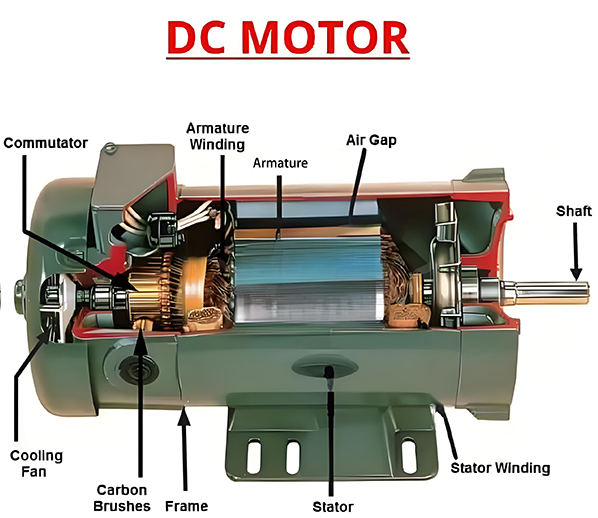
2. The Working Principle: Electromagnetic Interaction
2.1 Generation of the Rotating Magnetic Field
As mentioned earlier, the stator coils of a BLDC motor are energized with a three - phase AC current. The three - phase power supply creates a time - varying magnetic field in the stator windings. The phase difference between the three phases (usually 120 degrees) ensures that the magnetic field rotates. For example, when the current in one phase reaches its maximum, the currents in the other two phases are at different levels. This results in a magnetic field that rotates around the stator at a speed determined by the frequency of the applied AC voltage.
2.2 Interaction with the Rotor Magnets
The rotating magnetic field generated by the stator interacts with the permanent magnets on the rotor. According to the principles of electromagnetism, like poles repel and opposite poles attract. As the stator's magnetic field rotates, it attracts and repels the rotor magnets, causing the rotor to rotate. The synchronous nature of the interaction means that the rotor rotates at the same speed as the rotating magnetic field in the stator (in an ideal, no - load condition), which is why BLDC motors are also known as synchronous motors.
3. Control Mechanisms: Making the Motor Operate
3.1 Electronic Speed Controllers (ESCs)
To control the operation of a BLDC motor, an Electronic Speed Controller (ESC) is used. The ESC's main function is to convert the direct current (DC) power from the power source (such as a battery) into a three - phase AC power to drive the stator coils. It does this through a process called pulse - width modulation (PWM). The ESC adjusts the width of the pulses in the PWM signal, which in turn controls the voltage applied to the stator coils. By changing the voltage, the speed of the rotating magnetic field can be adjusted, and thus, the speed of the motor can be controlled.
3.2 Sensor - Based and Sensorless Control
3.2.1 Sensor - Based Control
In sensor - based BLDC motor control, sensors are used to determine the position of the rotor. Common types of sensors include hall effect sensors. These sensors are placed on the stator and can detect the magnetic field of the rotor magnets. Based on the information from the sensors, the ESC can precisely control the timing of the current applied to the stator coils. This ensures smooth operation, accurate speed control, and efficient torque generation, especially in applications where high precision is required, such as in robotic arms.
3.2.2 Sensorless Control
Sensorless BLDC motor control, on the other hand, does not rely on physical sensors to determine the rotor position. Instead, it uses electrical measurements, such as back - electromotive force (EMF) induced in the stator coils. When the motor rotates, the movement of the rotor magnets relative to the stator coils generates an EMF. By analyzing this EMF, the controller can estimate the rotor position and adjust the power supply accordingly. Sensorless control is often preferred in applications where cost - savings, simplicity, and reduced size are important, although it may have some limitations in terms of low - speed performance and accuracy compared to sensor - based control.
4. Advantages of Brushless DC Motors Stemming from Their Working Principle
4.1 High Efficiency
The design and working principle of BLDC motors contribute to their high efficiency. Since there are no brushes to create friction and electrical arcing, there is less energy loss due to mechanical and electrical resistance. The precise control of the magnetic field through the ESC also allows for optimized power usage, making BLDC motors much more efficient than their brushed counterparts.
4.2 Long Lifespan
The absence of brushes means that there is no wear - and - tear caused by the physical contact between the brushes and the commutator, which is a common failure point in brushed DC motors. This significantly increases the lifespan of BLDC motors, reducing the need for frequent maintenance and replacement.
4.3 High - Performance Operation
The ability to precisely control the speed and torque of BLDC motors, thanks to the electronic control mechanisms, enables high - performance operation. They can achieve rapid acceleration and deceleration, making them suitable for applications that require dynamic performance, such as in electric vehicles and high - speed fans.
In conclusion, brushless DC electric motors operate based on the interaction between a rotating magnetic field generated by the stator and the permanent magnets on the rotor. This interaction, combined with sophisticated control mechanisms, gives these motors their unique advantages. As technology continues to advance, we can expect even more innovative applications and improvements in the performance of BLDC motors.
以上全面解析了无刷直流电机的工作原理。若你希望对某部分内容进一步拓展,或有其他修改需求,欢迎随时告诉我。
How Does a DC Electric Motor Work
How Does a DC Motor Work
Related Article

Brushless DC (BLDC) motors are widely used in EVs, drones, industrial machinery, and robotics for their efficiency and long lifespan. Unlike brushed motors—where reversing direction only requires swapping power leads—BLDC motors rely on electronic commutation, making direction reversal more nuanced.
How to Reverse Direction in Brushless Motors

Brushed and brushless DC motors are two of the most common electric motor designs, powering everything from toys to electric vehicles. While both convert electrical energy to mechanical motion, their internal structures, performance, and use cases differ drastically.
What’s the Difference Between a Brushed and Brushless Motor

Brushed DC motors are reliable, but wear and tear over time can lead to failure. Whether you’re troubleshooting a power tool, household appliance, or industrial conveyor motor, knowing the signs of a bad brushed motor saves time and prevents further damage.
How to Know If a Brushed Motor Is Bad
