


Is a DC Motor the Same as an Electric Motor? Unraveling the Nuances
2025-09-05
Is a DC Motor the Same as an Electric Motor? Unraveling the Nuances
Walk into any electronics store or industrial workshop, and you’ll likely encounter devices powered by "electric motors." But mention "DC motors," and you might get a different reaction—curiosity, confusion, or technical jargon. This raises a fundamental question: Are these terms interchangeable? In short, no. A DC motor is a specific type of electric motor, not the entire category. Let’s dive into the technical details, performance metrics, and real-world applications that set them apart.
Defining the Terms: Electric Motor vs. DC Motor
What Is an Electric Motor?
An electric motor is a broad category of devices that convert electrical energy into mechanical energy through electromagnetic principles. Governed by Faraday’s law of electromagnetic induction, these machines rely on interactions between magnetic fields and current-carrying conductors to produce rotational motion. Electric motors encompass several subcategories, with the two primary classifications being AC (Alternating Current) motors and DC (Direct Current) motors. Additional "special motors" like stepper motors, servo motors, and linear motors also fall under this umbrella, each designed for specific applications requiring precise control or linear motion .
What Is a DC Motor?
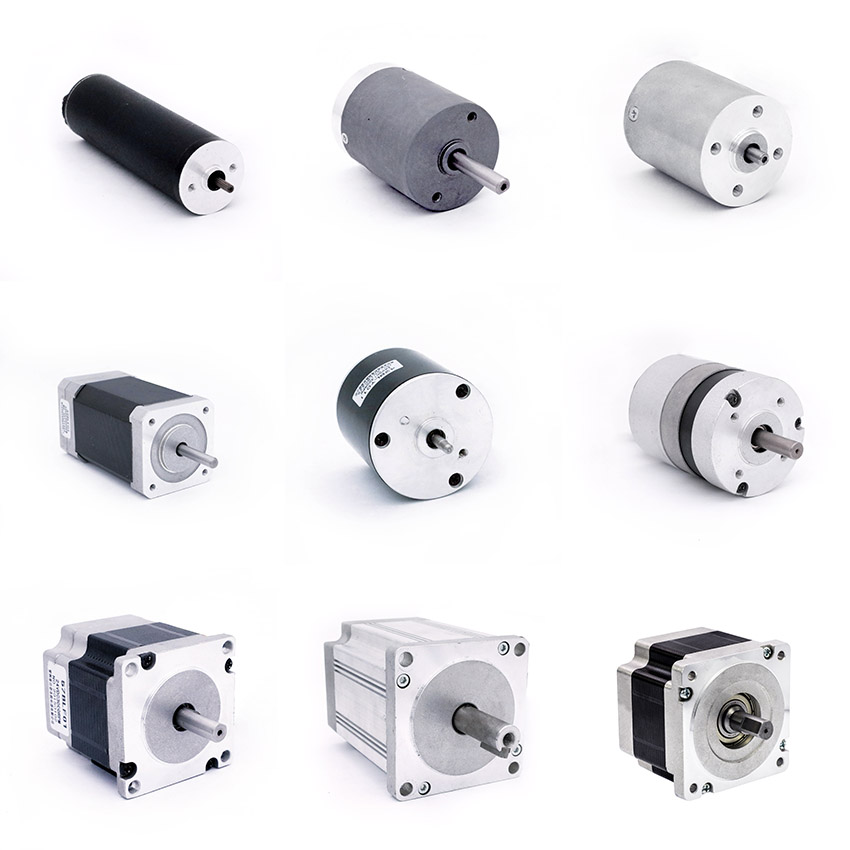
A DC motor is a subset of electric motors that operates using direct current (DC) power sources such as batteries or rectified power supplies. Its defining feature is the use of a commutator—a rotating electrical switch—that reverses current direction in the rotor windings to maintain continuous rotation. Modern DC motors include two main types: brushed DC motors (with physical commutators and brushes) and brushless DC (BLDC) motors, which replace mechanical commutation with electronic controllers. BLDC motors, in particular, have gained prominence for their high efficiency and low maintenance requirements, making them popular in applications from home appliances to electric vehicles .
Core Working Principles: How They Differ
The Mechanics of DC Motors
DC motors generate torque through the interaction between a stationary magnetic field (from permanent magnets or electromagnets in the stator) and a rotating armature (rotor) carrying direct current. In brushed DC motors, the commutator reverses current direction in the rotor windings as it spins, ensuring the magnetic force continues to rotate the shaft. BLDC motors eliminate physical brushes by using sensors and electronic controllers to switch current in the stator windings, creating a rotating magnetic field that pulls the permanent magnet rotor along .
This design difference has critical implications for performance. A 2023 IEEE study notes that BLDC motors achieve higher efficiency at high speeds due to their electronic commutation, which reduces energy losses from friction and electrical resistance .
The Mechanics of AC Motors
AC motors, by contrast, operate on alternating current, where the current direction reverses periodically. Induction motors—the most common AC type—use a rotating magnetic field in the stator to induce currents in the rotor, eliminating the need for physical connections to the rotor. Synchronous AC motors maintain rotation in sync with the AC power frequency, offering precise speed control. Unlike DC motors, AC motors typically lack commutators, relying instead on the natural oscillation of AC current to sustain rotation .
Torque characteristics differ significantly between the two types. AC induction motors produce higher torque at lower speeds, while DC motors deliver more torque at higher speeds—a key consideration for application selection .
Technical Performance Metrics: A Side-by-Side Comparison
Efficiency Ratings
Efficiency is a critical metric, measuring how much electrical energy converts to mechanical energy. AC motors generally lead in high-power applications, with efficiencies reaching up to 96% in hybrid engine systems . BLDC motors, however, excel in smaller-scale applications, with 2024 research showing optimized designs achieving over 90% efficiency—an 18% improvement in low-speed, low-torque scenarios compared to basic models .
For industrial applications, the International Electrotechnical Commission (IEC) classifies motors into efficiency grades: IE1 (standard), IE2 (high), IE3 (premium), and IE4 (super premium). IE4 AC motors, designed for continuous operation, offer the highest efficiency for large-scale industrial use .
Power Output and Torque
AC motors dominate high-power applications, with hybrid vehicle AC motors reaching up to 300 kW power and 2,000 Nm torque . DC motors in hybrid systems typically max out at 150 kW and 1,000 Nm, though their power-to-weight ratio makes them suitable for smaller devices like robotics and medical equipment .
Torque delivery also differs: AC motors provide stronger low-speed torque, ideal for heavy machinery starting under load, while DC motors offer better high-speed torque, making them suitable for tools and electric vehicles requiring rapid acceleration .
Speed Range and Control
AC motors boast a wider speed range, typically 0–15,000 rpm, making them suitable for applications like centrifugal compressors . DC motors, limited to 0–6,000 rpm in traditional designs, offer finer speed control through voltage adjustment—critical for applications like conveyor belts and 3D printers . BLDC motors, however, challenge this limitation, with high-speed models reaching 14,500 rpm, eliminating the need for gearboxes in some industrial systems .
Application Landscapes: Where Each Shines
DC Motor Applications
BLDC motors dominate in consumer electronics, home appliances, and electric vehicles, where efficiency and compact size matter. Their high power density makes them ideal for drones, electric scooters, and medical devices like insulin pumps . Brushed DC motors, though less efficient, remain cost-effective for low-power devices such as toys and small fans.
AC Motor Applications
AC motors power industrial infrastructure, including pumps, conveyor systems, and HVAC units. Three-phase induction motors are workhorses in manufacturing, while synchronous AC motors ensure precise speed in clocks and generators . In hybrid vehicles, AC motors’ high torque at low speeds enhances fuel efficiency and performance .
Specialized AC motors, like linear motors, find use in elevators and maglev trains, where linear motion replaces rotation .
FAQ
1. What’s the fundamental difference between a DC motor and an electric motor?
An electric motor is a broad category encompassing all devices converting electrical energy to mechanical energy. A DC motor is a specific type within this category that uses direct current and (in traditional designs) a commutator for operation.
2. Are brushless DC motors more efficient than AC motors?
It depends on the application. BLDC motors offer 90%+ efficiency in small-scale, high-speed scenarios, while AC motors reach up to 96% efficiency in large industrial or hybrid systems .
3. Can DC motors operate on AC power?
No, DC motors require direct current. However, brushless DC motors can use AC power with an electronic controller to rectify it to DC, enabling compatibility with standard electrical grids .
4. Why do electric vehicles use both AC and DC motors?
AC motors provide high torque for acceleration and efficient highway cruising, while DC motors (often BLDC) power auxiliary systems like power steering and climate control due to their compact size and precise control .
5. How do efficiency standards like IE4 affect motor selection?
IE4 standards ensure AC motors meet strict energy-saving criteria, making them mandatory for continuous-operation industrial applications in regions with energy regulations. DC motors, though not classified under IE standards, offer comparable efficiency in low-power contexts .
What Are the Disadvantages of DC Motors
What is the Main Function of a DC Motor
Related Article

Brushless DC (BLDC) motors are widely used in EVs, drones, industrial machinery, and robotics for their efficiency and long lifespan. Unlike brushed motors—where reversing direction only requires swapping power leads—BLDC motors rely on electronic commutation, making direction reversal more nuanced.
How to Reverse Direction in Brushless Motors

Brushed and brushless DC motors are two of the most common electric motor designs, powering everything from toys to electric vehicles. While both convert electrical energy to mechanical motion, their internal structures, performance, and use cases differ drastically.
What’s the Difference Between a Brushed and Brushless Motor

Brushed DC motors are reliable, but wear and tear over time can lead to failure. Whether you’re troubleshooting a power tool, household appliance, or industrial conveyor motor, knowing the signs of a bad brushed motor saves time and prevents further damage.
How to Know If a Brushed Motor Is Bad
