


What Is a Photoelectric Sensor
2025-07-05
What Is a Photoelectric Sensor?
In the realm of modern automation and smart technology, photoelectric sensors play a pivotal role in enabling devices to "see" and interact with their environment. These versatile sensors are used in everything from industrial assembly lines to consumer electronics, but what exactly are they, and how do they work? In this in-depth guide, we’ll explore the core concepts of photoelectric sensors, their operating principles, different types, real-world applications, and key considerations for selecting the right sensor for your needs. Whether you’re an engineer, a student, or a technology enthusiast, understanding photoelectric sensors is essential for appreciating their impact on modern automation.
Understanding Photoelectric Sensors: Core Definition and Basic Components
What Is a Photoelectric Sensor?
A photoelectric sensor is an electronic device that detects the presence, absence, or distance of an object by using light as a medium for detection. Unlike mechanical or contact-based sensors, photoelectric sensors operate non-contact, making them ideal for applications where precision, speed, or delicate object handling is required. They work by emitting a light beam (usually infrared, visible red, or laser) and measuring changes in the light’s intensity as it reflects off an object or is interrupted by it.
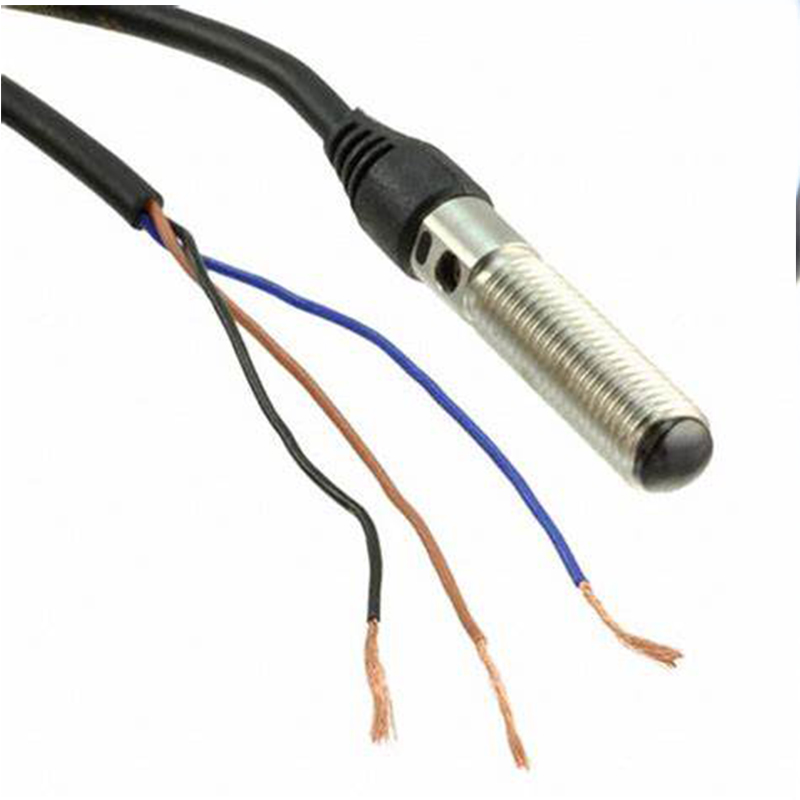
Key Components of a Photoelectric Sensor
- Emitter (Transmitter):
Generates the light beam. This can be a light-emitting diode (LED), a laser diode, or a halogen lamp. LEDs are the most common due to their energy efficiency and long lifespan, while lasers offer higher precision for long-distance or small-spot applications.
- Receiver (Detector):
Captures the light beam emitted by the emitter. It typically uses a photodiode, phototransistor, or photomultiplier tube to convert light energy into an electrical signal. The receiver compares the incoming light intensity to a reference threshold to determine if an object is present.
- Detection Circuit:
Processes the signal from the receiver, triggering an output (e.g., an electrical pulse or analog voltage) when the detected light level crosses a predefined threshold. Modern sensors often include microcontrollers for advanced features like adjustable sensitivity, noise filtering, and communication interfaces.
How Photoelectric Sensors Work: The Fundamental Principle of Light-Based Detection
The Basic Detection Process
- Light Emission: The emitter sends out a continuous or pulsed light beam in a specific direction.
- Light Interaction: The beam interacts with the target object in one of three ways:
-
- The object interrupts the beam (direct beam mode).
-
- The object reflects the beam back to the receiver (reflective mode).
-
- The object scatters some of the beam to the receiver (diffuse reflection mode).
- Signal Generation: The receiver measures the change in light intensity. If the change exceeds the sensor’s sensitivity threshold, it generates an output signal indicating the presence or absence of the object.
Key Concepts in Photoelectric Sensing
- Modulated Light: To reduce interference from ambient light (e.g., sunlight or room lighting), most sensors emit modulated light (flashing at a specific frequency). The receiver is tuned to detect only this frequency, ignoring constant or untuned light sources.
- Wavelength Selection: Different sensors use specific light wavelengths (e.g., 660 nm for red LED, 850 nm for infrared) to optimize performance for different target materials. For example, infrared light works well for detecting clear or transparent objects, while laser light offers pinpoint accuracy for tiny targets.
- Beam Characteristics: The shape and divergence of the light beam affect detection range and precision. Laser sensors produce narrow, collimated beams for long distances (up to hundreds of meters), while LED sensors have wider beams suitable for short to medium ranges (up to a few meters).
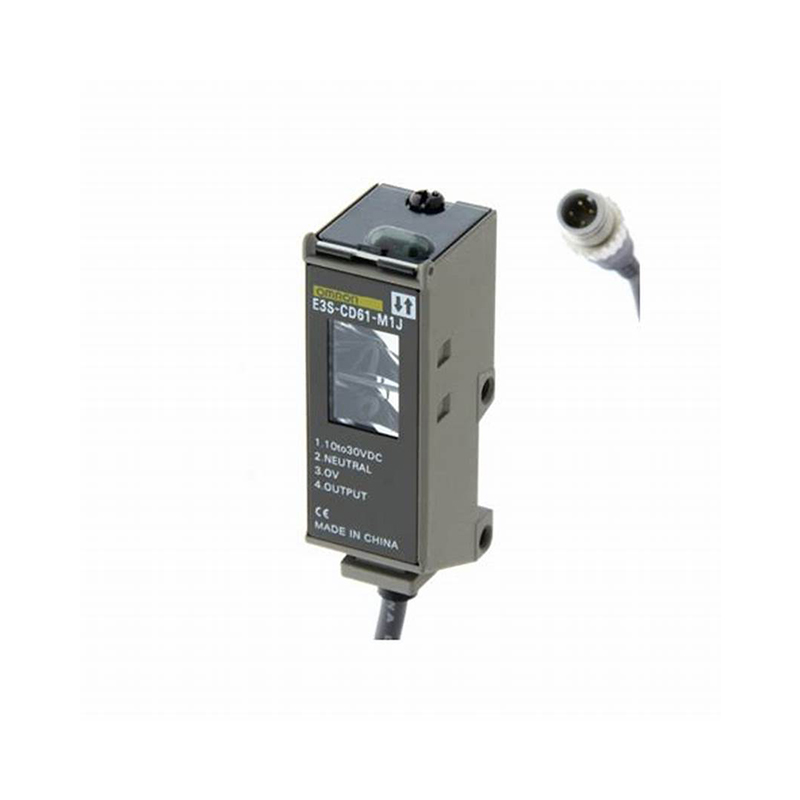
Types of Photoelectric Sensors: Classified by Detection Mode
Photoelectric sensors are primarily categorized by how the light beam is emitted and detected. Let’s explore the main types and their unique characteristics:
1. Through-Beam (Direct Beam) Sensors
- Structure: The emitter and receiver are separate units, positioned facing each other with a clear optical path between them.
- Operation: The sensor detects an object when it interrupts the direct light beam between the emitter and receiver. If the receiver no longer detects the beam (or its intensity drops below a threshold), it triggers an output.
- Pros:
-
- Long detection range (up to 50 meters for laser models).
-
- High accuracy, as even small objects can block the beam.
-
- Less affected by target color or surface texture (since detection relies on beam interruption, not reflection).
- Cons:
-
- Requires precise alignment between emitter and receiver.
-
- Bulky setup due to two separate units.
- Applications: Industrial conveyor belts (detecting missing packages), security systems (break-beam alarms), and assembly lines (counting parts).
2. Retroreflective (Reflective with Target) Sensors
- Structure: The emitter and receiver are housed in the same unit, paired with a retroreflective target (a special mirror or prism) placed opposite the sensor.
- Operation: The emitter sends a beam to the retroreflective target, which reflects it back to the receiver. When an object passes between the sensor and the target, it partially or fully blocks the reflected beam, triggering a detection.
- Key Feature: Retroreflective targets use corner-cube optics to reflect light back along the same path, even if slightly misaligned. This allows longer ranges (up to 10 meters) compared to diffuse sensors.
- Pros:
-
- Single-unit design (emitter and receiver together), easier to install than through-beam.
-
- Longer range than diffuse sensors without needing a separate receiver.
-
- Less sensitive to ambient light due to modulated light and retroreflective efficiency.
- Cons:
-
- Requires a dedicated retroreflective target, adding cost and setup complexity.
-
- Performance depends on target alignment and cleanliness (dirt on the target reduces reflection).
- Applications: Packaging machines (detecting seal integrity), automatic doors (object detection), and logistics (sorting conveyor systems).
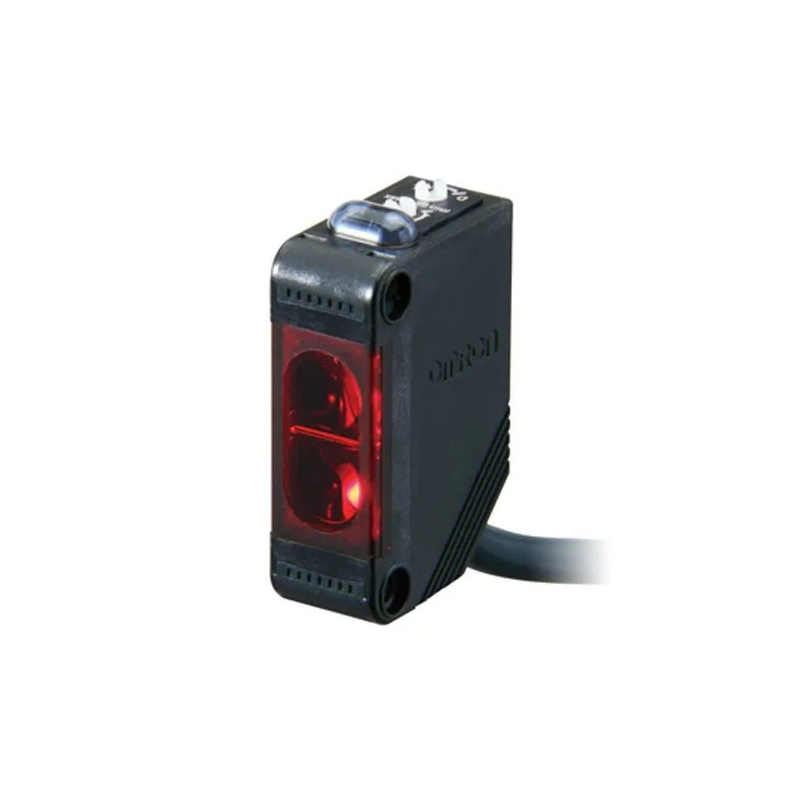
3. Diffuse Reflective Sensors
- Structure: Emitter and receiver are in the same housing, with no external target. The receiver is angled to detect light scattered (diffused) by the target object.
- Operation: The emitter emits a beam, and the receiver detects the light reflected off the object’s surface. Detection occurs when the reflected light intensity exceeds the sensor’s sensitivity threshold.
- Key Factors:
-
- Detection Range: Shorter than through-beam or retroreflective (typically up to 2 meters), as it depends on the object’s reflectivity. Dark objects reflect less light, reducing the effective range.
-
- Surface Texture: Matte surfaces scatter more light than glossy ones, improving detection for diffuse sensors.
- Pros:
-
- No need for a separate target or receiver, making them compact and easy to install.
-
- Versatile for detecting objects of varying colors and textures (with adjustable sensitivity).
- Cons:
-
- Shorter range and more sensitive to target properties (color, shape, surface).
-
- Ambient light can interfere if not properly modulated.
- Applications: Retail inventory systems (shelf empty detection), food processing (object counting), and consumer electronics (smart home devices like automatic trash cans).
4. Thru-Hole (Slot) Sensors
- Structure: A compact unit with an emitter and receiver separated by a fixed gap (the "slot"), forming a through-beam configuration in a single housing.
- Operation: An object passing through the slot interrupts the direct beam between the emitter and receiver, triggering a detection.
- Pros:
-
- Extremely precise for detecting small objects or fast-moving parts (e.g., paper in printers).
-
- No need for external alignment since the emitter and receiver are fixed in position.
- Cons:
-
- Limited detection range (only within the slot gap, typically a few millimeters to centimeters).
- Applications: Printers (paper jam detection), ticket machines (ticket presence), and small parts assembly (detecting tiny components).
5. Fiber-Optic Sensors
- Structure: Combines a photoelectric sensor head with fiber-optic cables that carry the light beam to and from the target. The main sensor (emitter/receiver) is connected to a fiber-optic probe via flexible cables.
- Operation: The emitter sends light through the fiber to the probe, which emits it toward the target. Reflected light returns through the fiber to the receiver.
- Pros:
-
- Allows sensing in tight spaces or harsh environments (e.g., high heat, moisture, or vibration) where traditional sensors can’t fit.
-
- Adjustable probe shapes (straight, right-angle, micro-probes) for versatile mounting.
- Cons:
-
- Fiber cables can be fragile and require careful handling.
-
- Slightly lower efficiency due to light loss in the fibers.
- Applications: Medical devices (endoscopes with optical sensing), automotive manufacturing (engine compartment inspections), and semiconductor fabrication (micro-component detection).
Real-World Applications of Photoelectric Sensors
1. Industrial Automation and Manufacturing
- Conveyor Systems: Through-beam and retroreflective sensors track the movement of boxes, pallets, or parts on assembly lines, ensuring proper spacing and detecting jams.
- Quality Control: Diffuse sensors check for the presence of labels, caps, or components on products, while laser-based sensors measure object dimensions with high precision.
- Robotics: Fiber-optic sensors enable robots to pick up delicate objects (e.g., glass vials or electronic components) by detecting their presence and position without physical contact.
2. Smart Devices and Consumer Electronics
- Automatic Doors and Lights: Retroreflective and diffuse sensors detect human presence in smart homes, offices, or retail stores, triggering door opening or adjusting lighting levels.
- Printers and Scanners: Thru-hole sensors detect paper alignment and jams, while infrared diffuse sensors in mobile devices sense proximity (e.g., turning off the screen during calls).
- Wearable Tech: Some fitness trackers use photoelectric sensors to measure heart rate via optical plethysmography (PPG), detecting blood volume changes through the skin.
3. Logistics and Warehousing
- Inventory Management: Barcode scanners with photoelectric sensors quickly read labels on packages, enabling automated sorting and tracking in warehouses.
- Pallet Detection: Retroreflective sensors identify the presence of pallets on storage racks, optimizing space utilization and preventing collisions in automated guided vehicles (AGVs).
4. Healthcare and Medical Devices
- Patient Monitoring: Diffuse sensors in hospital beds detect patient movement or weight changes, alerting caregivers to potential issues.
- Surgical Equipment: Fiber-optic sensors in laparoscopic tools provide real-time feedback on tissue proximity, enhancing precision during minimally invasive surgeries.
- Medical Imaging: Some X-ray machines use photoelectric sensors to regulate exposure levels based on patient size and position.
5. Security and Surveillance
- Perimeter Protection: Through-beam sensors create invisible barriers to detect intruders, while retroreflective sensors monitor door and window openings.
- CCTV Systems: Light-level sensors adjust camera exposure in varying lighting conditions, ensuring clear footage day and night.
Advantages and Challenges of Photoelectric Sensors
Key Advantages
- Non-Contact Detection: No physical wear and tear, making them suitable for delicate or high-value objects.
- High Speed: Capable of detecting fast-moving objects (e.g., up to 10,000 objects per minute in industrial settings).
- Versatility: Available in multiple types (through-beam, retroreflective, diffuse) to suit different distances, target materials, and environments.
- Precision: Laser-based sensors can detect objects with micrometer-level accuracy, critical for applications like semiconductor manufacturing.
- Easy Integration: Most sensors offer standard output interfaces (e.g., NPN/PNP, analog voltage, USB), making them compatible with PLCs, microcontrollers, and IoT systems.
Common Challenges and Solutions
- Ambient Light Interference:
-
- Issue: Sunlight or bright LEDs can overwhelm the receiver, causing false readings.
-
- Solution: Use modulated light (flashing at a specific frequency) and select sensors with wavelength filters (e.g., infrared to ignore visible light).
- Dust and Contamination:
-
- Issue: Dirt, moisture, or debris on the emitter/receiver lens or retroreflective target reduces light transmission.
-
- Solution: Install protective covers, choose sensors with self-cleaning features, or schedule regular maintenance.
- Target Reflectivity Variations:
-
- Issue: Dark or matte objects reflect less light, reducing diffuse sensor range; shiny objects may cause glare.
-
- Solution: Use through-beam sensors for reliable detection regardless of target color, or opt for sensors with adjustable gain/sensitivity.
- Alignment Difficulty:
-
- Issue: Misalignment between emitter and receiver in through-beam or retroreflective setups can reduce performance.
-
- Solution: Use sensors with alignment indicators (e.g., LED status lights) or laser pointers for precise positioning.
Choosing the Right Photoelectric Sensor: Key Selection Criteria
- Detection Mode:
-
- Use through-beam for long ranges and high precision.
-
- Use retroreflective when a single-unit design is needed with moderate range.
-
- Use diffuse for short-range, no-target applications where object color/texture is consistent or adjustable.
- Detection Range:
-
- Short range (0-50 cm): Diffuse sensors or thru-hole sensors.
-
- Medium range (50 cm-5 m): Retroreflective sensors or high-sensitivity diffuse sensors.
-
- Long range (5 m+): Through-beam sensors (especially laser-based) or retroreflective with high-efficiency targets.
- Target Characteristics:
-
- Size: Small objects (e.g., 1mm parts) require laser sensors with narrow beams.
-
- Color/Texture: Dark objects need higher-power emitters or through-beam mode; transparent objects may require infrared or special polarization filters.
-
- Material: Glossy surfaces (metal, plastic) may cause specular reflection—use diffuse sensors with angled receivers to capture scattered light.
- Environmental Conditions:
-
- Temperature: Choose sensors rated for high/low temperatures (e.g., -40°C to +85°C for industrial use).
-
- Moisture/Dust: Look for IP67 or higher ingress protection ratings for wet or dusty environments.
-
- Vibration/Shock: Rigid mounting or fiber-optic sensors can mitigate issues from mechanical stress.
- Output Type:
-
- Digital (Switching): Outputs a binary signal (ON/OFF) for presence/absence detection (e.g., PNP/NPN transistors).
-
- Analog: Provides a continuous voltage/current signal (e.g., 0-10V, 4-20mA) for distance measurement or level sensing.
-
- Communication Interfaces: Ethernet, RS-485, or IO-Link for integrating with smart systems and remote monitoring.
Conclusion: The Light-Driven Eyes of Modern Technology
Photoelectric sensors are the "eyes" of automation, enabling machines and devices to perceive their surroundings with precision and speed. From the simplest consumer gadgets to complex industrial robots, their ability to detect objects non-contact, across varying distances and environments, makes them indispensable in modern technology.
By understanding their core principles—how they emit and detect light, the different types available, and their applications—you can make informed decisions when selecting a sensor for your project. Whether you’re building a smart home device, optimizing a manufacturing line, or designing a medical instrument, the right photoelectric sensor will ensure reliable, efficient, and accurate detection.
As technology continues to advance, expect even more innovative uses for photoelectric sensors—from miniaturized fiber-optic probes in microelectronics to adaptive sensors that auto-calibrate for changing environments. Their versatility and precision ensure that they will remain a cornerstone of sensing technology for years to come.
How to Test a Photoelectric Sensor
What is the Difference Between Brushed and Brushless Motors
Related Article

Brushless DC (BLDC) motors are widely used in EVs, drones, industrial machinery, and robotics for their efficiency and long lifespan. Unlike brushed motors—where reversing direction only requires swapping power leads—BLDC motors rely on electronic commutation, making direction reversal more nuanced.
How to Reverse Direction in Brushless Motors

Brushed and brushless DC motors are two of the most common electric motor designs, powering everything from toys to electric vehicles. While both convert electrical energy to mechanical motion, their internal structures, performance, and use cases differ drastically.
What’s the Difference Between a Brushed and Brushless Motor

Brushed DC motors are reliable, but wear and tear over time can lead to failure. Whether you’re troubleshooting a power tool, household appliance, or industrial conveyor motor, knowing the signs of a bad brushed motor saves time and prevents further damage.
How to Know If a Brushed Motor Is Bad
