


What Is a Stepper Motor Used For
2025-06-28
What Is a Stepper Motor Used For?
Stepper motors are the backbone of precision motion control in modern technology, valued for their ability to convert electrical pulses into discrete, repeatable movements. Unlike traditional motors that offer continuous rotation, steppers excel in applications requiring exact positioning, open-loop reliability, and holding torque—making them indispensable across industries from manufacturing to medicine. This guide explores the diverse real-world uses of stepper motors, highlighting why they’re chosen for specific tasks and how their unique features solve practical engineering challenges.
1. Industrial Automation: The Workhorse of Manufacturing
In industrial settings, precision and repeatability are non-negotiable. Stepper motors dominate here due to their ability to follow precise digital commands without complex feedback systems.
1.1 CNC Machines and Machine Tools
- Role: Control X/Y/Z axes for milling, drilling, and cutting in CNC routers, lathes, and milling machines.
- Why Steppers?:
-
- Micron-Level Precision: Micro-stepping (e.g., 1/32 steps) enables movements as small as 0.005mm, critical for machining intricate parts.
-
- Holding Torque: Maintains position during tool changes or pauses, eliminating drift.
- Example: A NEMA 23 hybrid stepper with 1.8° native step angle, used in a PCB drilling machine to create 0.1mm-diameter holes with ±5μm accuracy.
1.2 Robotic Arms and Pick-and-Place Systems
- Application: Assembling electronics, packaging goods, and material handling in warehouses.
- Stepper Advantages:
-
- High Torque at Low Speeds: Essential for lifting loads at precise angles (e.g., 0.9° steps for joint articulation).
-
- Synchronous Motion: Coordinated step pulses ensure multi-axis robots move in unison, critical for delicate operations like semiconductor wafer handling.
- Case Study: A 6-axis robotic arm in an automotive factory uses NEMA 17 steppers with closed-loop feedback (encoders) to achieve 0.01° angular resolution in welding applications.
1.3 Conveyor Systems and Material Handling
- Function: Positioning boxes, bottles, or raw materials on production lines.
- Stepper Benefits:
-
- Indexing Capability: Moves items to exact positions (e.g., 25mm per step) for labeling, sorting, or quality inspection.
-
- Reliability in Harsh Environments: Dust- and moisture-resistant designs (e.g., sealed NEMA 34 motors) for food processing or chemical plants.
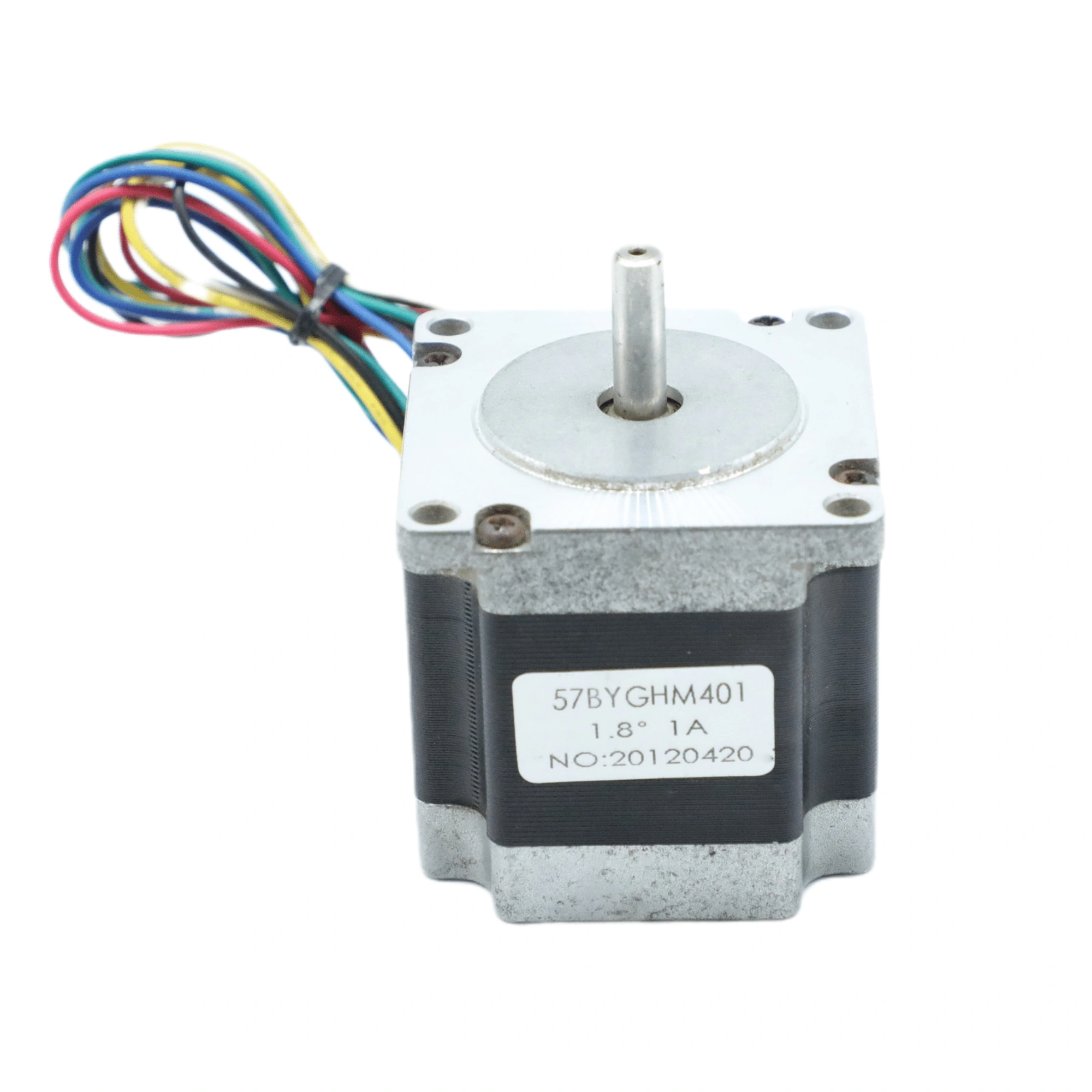
2. 3D Printing and Creative Fabrication: Building the Future Layer by Layer
Stepper motors are the unsung heroes of 3D printers, enabling the precise layer deposition that brings digital designs to life.
2.1 Axis Movement (X, Y, Z)
- Role: Move the print head and build platform with sub-millimeter accuracy.
- Technical Edge:
-
- Micro-Stepping for Detail: 1/16 micro-stepping on a 1.8° motor achieves 0.1125° steps, translating to 0.04mm linear movement (with a 0.8mm lead screw).
-
- Open-Loop Simplicity: No need for encoders in most FDM printers, reducing cost and complexity.
- Example: A Prusa i3 printer uses three NEMA 17 steppers: one for the extruder (filament feed) and two for bed movement, achieving 0.1mm layer height.
2.2 Extruder and Filament Control
- Function: Push plastic filament into the hot end at a constant rate.
- Stepper Advantage:
-
- Consistent Feed Rate: Steady step pulses ensure uniform extrusion, critical for avoiding under/over-extrusion (e.g., 40 steps per millimeter of filament).
-
- Backlash Resistance: Holding torque prevents filament slippage during retraction moves.
2.3 Advanced Fabrication Techniques
- Dual Extrusion: Steppers enable switching between materials (PLA, ABS, supports) with precise retraction.
- SLA/LCD Printers: Used in Z-axis for lifting the build plate in resin-based printers, requiring smooth motion to avoid layer misalignment.
3. Medical Devices: Precision Where Lives Depend
In healthcare, stepper motors deliver the accuracy and reliability needed for diagnostics, surgery, and patient care.
3.1 Surgical Robotics and Minimally Invasive Procedures
- Application: Robotic arms in da Vinci-style systems for prostatectomy or laparoscopy.
- Key Features:
-
- Sub-Millimeter Control: Micro-stepping (1/64 steps) allows surgeons to rotate instruments in 0.028° increments, mimicking human hand dexterity.
-
- Quiet Operation: Hybrid steppers with dampened windings reduce noise in operating rooms.
3.2 Diagnostic and Laboratory Equipment
- Examples:
-
- Syringe Pumps: Dispense microliters of reagents with stepper-driven plunger movement (e.g., 0.1μL resolution in HPLC systems).
-
- Centrifuges: Precise speed control (±0.1 RPM) for cell separation, achieved via stepper-driven belt drives.
- Why Steppers?: Holding torque maintains pump positions during calibration, and open-loop control simplifies validation in FDA-regulated devices.
3.3 Rehabilitation and Mobility Aids
- Function: Power wheelchairs, exoskeletons, and limb prosthetics.
- Stepper Benefits:
-
- Torque on Demand: High starting torque for lifting weights (e.g., a leg exoskeleton’s knee joint requires 5N·m at 0 RPM).
-
- Energy Efficiency: Sleep mode reduces battery drain when stationary, critical for portable devices.
4. Consumer Electronics: Enhancing Everyday Devices
From cameras to smart home gadgets, stepper motors add precision to consumer products without breaking the bank.
4.1 Imaging and Photography
- Camera Lenses:
-
- Autofocus/Zoom: Steppers in DSLR lenses (e.g., Canon EF-S 18-55mm) move lens elements in 0.01mm increments for fast, silent focusing.
-
- Aperture Control: Adjusts diaphragm blades with 1/3-stop precision (e.g., f/2.8 to f/4 in 12 steps).
- 360° Cameras: Rotate sensors or lenses for panoramic shots, using tiny NEMA 8 steppers for compact designs.
4.2 Printers and Scanners
- Function:
-
- Paper Feed: Steppers in inkjet printers move paper exactly 0.084mm per step (for 300 DPI resolution).
-
- Print Head Movement: Linear steppers in wide-format printers traverse up to 2 meters with ±0.1mm accuracy.
- Advantage: Low-cost open-loop control meets consumer expectations for reliability and speed.
4.3 Smart Home and IoT Devices
- Applications:
-
- Blinds/Curtains: Quiet NEMA 11 steppers with 7.5° steps rotate shafts to adjust light levels (e.g., Xiaomi Smart Curtain Motor).
-
- Robotic Vacuums: Steer wheels and adjust brush heights, using encoders for closed-loop navigation in high-end models.
5. Scientific Research and Precision Instruments
In labs and research facilities, stepper motors enable experiments requiring nanometer-scale control.
5.1 Microscopy and Imaging Systems
- Role: Position sample stages in electron microscopes or confocal microscopes.
- Technical Specs:
-
- Nanometer Resolution: Combined with lead screws, 1/256 micro-stepping achieves 1nm steps (e.g., in a Nikon Eclipse Ti2 inverted microscope).
-
- Vibration-Free Motion: Passive damping and low-resonance drivers critical for long-exposure imaging.
5.2 Material Testing and Analysis
- Examples:
-
- Tensile Testing Machines: Extend samples at 0.01mm/min using stepper-driven lead screws, measuring stress with ±0.1% accuracy.
-
- Spectrometers: Rotate diffraction gratings in 0.001° increments to analyze light spectra.
5.3 Astronomy and Telescope Mounts
- Function: Track celestial objects by countering Earth’s rotation.
- Stepper Features:
-
- High Torque at Zero Speed: Holds telescope position against wind loads.
-
- Precision Gearing: 1:100 gear reduction with steppers ensures 0.0001° per step for long-exposure astrophotography.
6. Automotive and Transportation: Reliable Motion in Demanding Environments
While servos dominate in electric vehicles, steppers play niche roles requiring precise, cost-effective control.
6.1 Vehicle Subsystems
- Applications:
-
- Seat Adjustment: Move lumbar supports in 1mm increments using NEMA 14 steppers with gearboxes.
-
- Headlight Alignment: Adjust vertical/horizontal angles to comply with ISO standards (e.g., ±5° with 0.1° resolution).
- Why Steppers?: Low power consumption (12V operation) and resistance to temperature fluctuations (-40°C to 85°C).
6.2 Hybrid/Electric Vehicle (HEV/EV) Components
- Function:
-
- Cooling System Valves: Control coolant flow in battery packs with stepper-driven 蝶阀,responding to ECU signals in <50ms.
-
- Charging Port Alignment: Position robotic arms to connect charging cables in autonomous EV chargers.
7. Choosing the Right Stepper Motor for Your Application
When selecting a stepper for a specific use case, prioritize these factors:
7.1 Key Performance Metrics
|
Application Need
|
Critical Specs
|
Example Use Case
|
|
High precision
|
Step angle (≤1.8°), micro-stepping capability
|
3D printer, CNC router
|
|
Heavy loads
|
Holding torque (≥2N·m), NEMA 23/34 frame size
|
Industrial robotic arm
|
|
Space-constrained
|
Small form factor (NEMA 8/11), low profile
|
Camera lens, smart home devices
|
|
Harsh environments
|
IP65 rating, sealed windings
|
Food processing, outdoor machinery
|
|
Low noise
|
Micro-stepping, anti-vibration coatings
|
Medical devices, consumer electronics
|
7.2 Industry-Specific Considerations
- Medical: Biocompatible materials (e.g., PEEK gears) and EMI shielding for MRI compatibility.
- Aerospace: Lightweight aluminum construction and radiation tolerance for satellite mechanisms.
- Automotive: AEC-Q100 certification for temperature and vibration resistance.
8. Future Trends: Expanding Horizons for Stepper Applications
- Miniaturization: Sub-NEMA 8 motors (e.g., 12mm diameter) for wearable devices and micro-robots.
- Integration with AI: Self-tuning drivers that optimize step modes based on real-time load data (e.g., predictive maintenance in factories).
- Sustainable Design: Energy-efficient steppers with 90%+ motor-driver system efficiency, reducing carbon footprints in industrial plants.
Conclusion
Stepper motors are far more than just "motors that move in steps"—they’re versatile solutions tailored to the precision needs of modern technology. From enabling nanometer-scale movements in research labs to powering the 3D printers that build prototype parts, their ability to combine accuracy, reliability, and cost-effectiveness makes them irreplaceable across industries.
As technology demands ever higher precision and efficiency, stepper motors will continue to evolve—whether through smarter drivers, smaller form factors, or integration with advanced feedback systems. By understanding their unique strengths and applying them to the right use cases, engineers and creators can unlock new possibilities in automation, fabrication, and innovation.
How to Adjust Stepper Motor Current
How to Control a Stepper Motor
Related Article

Brushless DC (BLDC) motors are widely used in EVs, drones, industrial machinery, and robotics for their efficiency and long lifespan. Unlike brushed motors—where reversing direction only requires swapping power leads—BLDC motors rely on electronic commutation, making direction reversal more nuanced.
How to Reverse Direction in Brushless Motors

Brushed and brushless DC motors are two of the most common electric motor designs, powering everything from toys to electric vehicles. While both convert electrical energy to mechanical motion, their internal structures, performance, and use cases differ drastically.
What’s the Difference Between a Brushed and Brushless Motor

Brushed DC motors are reliable, but wear and tear over time can lead to failure. Whether you’re troubleshooting a power tool, household appliance, or industrial conveyor motor, knowing the signs of a bad brushed motor saves time and prevents further damage.
How to Know If a Brushed Motor Is Bad
